The Monthly Dose: June 2026
Posted by Jorge Francisco on
The Monthly Dose
June 2026
Insights, advocacy, and updates from NBPAS
Policy Watch
DOJ Files Statement of Interest in AOA v. ABIM Case
Department of Justice filing highlights concerns about professional self-regulation and competition in physician certification.
The U.S. Department of Justice recently filed a Statement of Interest in litigation involving the American Board of Internal Medicine (ABIM), emphasizing that professional certification organizations are not automatically exempt from federal antitrust scrutiny. The Department noted that organizations composed of active market participants may raise competition concerns when they establish standards that govern access to a profession.
While the DOJ's filing arose in the context of ABIM litigation, many of the issues identified by the Department mirror concerns long raised by NBPAS regarding competition within physician certification.
The filing represents an important and encouraging development as questions surrounding physician certification, competition, physician mobility, and patient access receive increasing attention at the federal level. NBPAS continues to elevate this issue as we work to bring choice and competition to all physicians.
Read more here: https://www.justice.gov/atr/media/1445746/dl?inline
CMS Asks: "Who Watches the Watchmen?"
New CMS oversight of accrediting organizations reflects growing federal interest in accountability, transparency, and oversight of private standard-setting organizations.
The Centers for Medicare & Medicaid Services (CMS) recently finalized new rules strengthening federal oversight of healthcare accrediting organizations that survey more than 9,000 healthcare providers and suppliers nationwide.
CMS cited concerns regarding conflicts of interest, inconsistent survey practices, and the need for greater accountability among organizations entrusted with evaluating healthcare providers. CMS Administrator Dr. Mehmet Oz summarized the agency's approach by asking, "Who watches the watchmen?" adding that organizations exercising these responsibilities must themselves remain subject to oversight and accountability.
The new rules establish enhanced oversight, increased transparency, stronger conflict-of-interest protections, and greater consistency between accrediting organizations and government survey agencies.
While these changes apply specifically to healthcare accrediting organizations, they reflect a broader policy discussion regarding the role of private organizations that establish standards affecting participation in healthcare. Questions surrounding accountability, transparency, conflicts of interest, and oversight are increasingly receiving attention from federal agencies.
These developments reflect a broader federal interest in examining how private organizations establish standards that influence physician practice, workforce mobility, competition, and patient access to care. These are many of the same issues NBPAS has long worked to address, and we welcome the increased attention they are now receiving.
Read more here: https://www.cms.gov/newsroom/press-releases/cms-ensures-accrediting-organizations-uphold-trust-standards-oversight
From the NBPAS Desk
NEW Resource for Hospital Credentialing Teams
Over the years, many physicians have helped introduce NBPAS within their own organizations. One thing we've learned is that having clear, accessible information available for credentialing teams can make those conversations much easier.
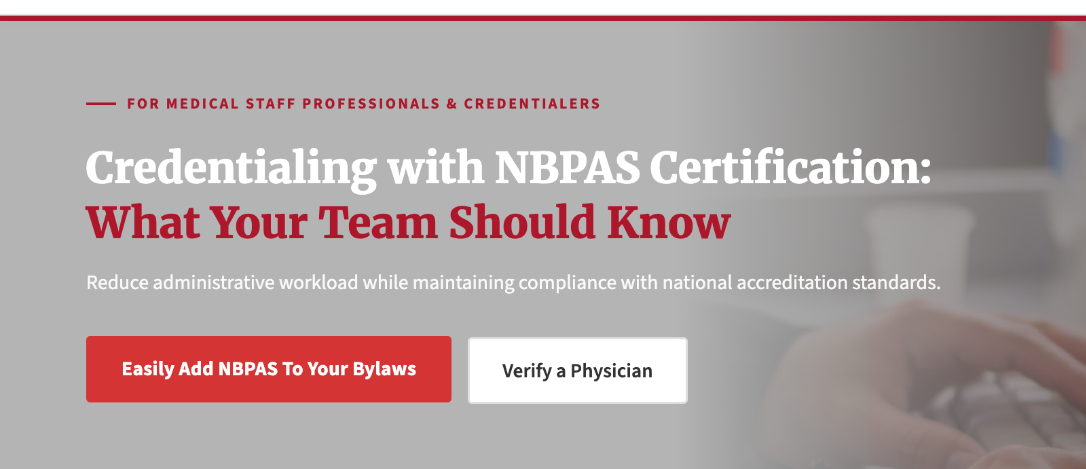
That's why we've created a new resource page specifically for hospitals, medical staff professionals, and credentialing teams.
The page includes an overview of NBPAS certification, verification resources, accreditation alignment, sample bylaw language, and answers to common questions that arise during credentialing and medical staff discussions.
Whether your hospital already recognizes NBPAS or your organization is beginning to explore recognition, this resource is designed to support productive conversations and provide credentialing teams with the information they need.
If your hospital has not yet recognized NBPAS, we encourage you to share this resource with your credentialing office, medical staff services department, or physician leadership team.
One Thing You Can Do This Month
Make Your Certification Visible
One of the easiest ways to support NBPAS is simply to use your credential.
Adding DNBPAS to your email signature, professional biography, conference presentations, and online profiles helps increase awareness and recognition among colleagues, administrators, and credentialing teams.
Example:
Jane Smith, M.D., DNBPAS
As more diplomates proudly display their certification, NBPAS becomes increasingly visible throughout hospitals, medical staffs, and healthcare organizations. Small actions by thousands of physicians can make a meaningful difference.
Frequently Asked Question
"Why should I maintain NBPAS if my hospital doesn't recognize it?"
It's a fair question, and one we hear from physicians often.
While many hospitals, health systems, payers, and employers now recognize NBPAS, others have not yet updated their policies. Progress takes time, and physician participation remains essential to that progress.
Every physician who maintains NBPAS helps demonstrate that there is meaningful demand for an alternative to traditional Maintenance of Certification. Growth in physician participation strengthens conversations with hospitals, employers, credentialing organizations, policymakers, and legislators.
The recent attention from the Department of Justice regarding competition in physician certification and CMS's increased oversight of organizations that establish healthcare standards highlights the importance of these discussions.
Simply put, if physicians do not support alternatives, alternatives cannot survive.
By maintaining your certification, you are supporting a physician-led model focused on continuing education, professional development, and patient care and helping preserve a meaningful choice for future physicians.
Physicians Supporting Physicians

More than 15,000 physicians across the country have chosen NBPAS as their pathway for continuing certification.
Founded by physicians, NBPAS believes continuing certification should support lifelong learning, professional development, and patient care — not repeated high-stakes testing and unnecessary administrative burden.
NBPAS emphasizes:
- Specialty-specific continuing medical education
- Ongoing professional development
- A practical, evidence-based approach to continuous certification
Requirements include:
- Initial certification from an ABMS or AOA board
- An active, unrestricted medical license
- 50 hours of specialty-specific Category 1 CME within the past 24 months
Joining NBPAS means becoming part of a growing community of physicians committed to preserving meaningful choice in continuing certification.
The online application takes less than six minutes to complete.
Suggestions
Have an idea, need help? Reach out to NBPAS at info@nbpas.org.
Someone from the team will be happy to get back to you.