The Monthly Dose: May 2026
Posted by Jorge Francisco on
The Monthly Dose
May 2026
Insights, advocacy, and updates from NBPAS
From the NBPAS Desk
Dr. Paul Teirstein Featured in Medscape Discussion
A recent Medscape article featuring comments from NBPAS President Dr. Paul Teirstein explores many of the issues physicians continue to raise around continuous certification, including administrative burden, repeated testing, relevance to clinical practice, and the growing interest in alternatives such as NBPAS.
Dr. Teirstein speaks to something many physicians have felt for years: physicians can uphold high standards and remain engaged in lifelong learning without unnecessary layers of testing and administrative burden.
The article also highlights how these discussions are increasingly extending beyond physicians alone, with hospitals, credentialing bodies, specialty societies, and healthcare leaders continuing to re-examine what continuing certification should look like in modern medical practice.
For many physicians, these are no longer theoretical conversations. They increasingly affect credentialing, professional mobility, administrative workload, and everyday clinical practice.
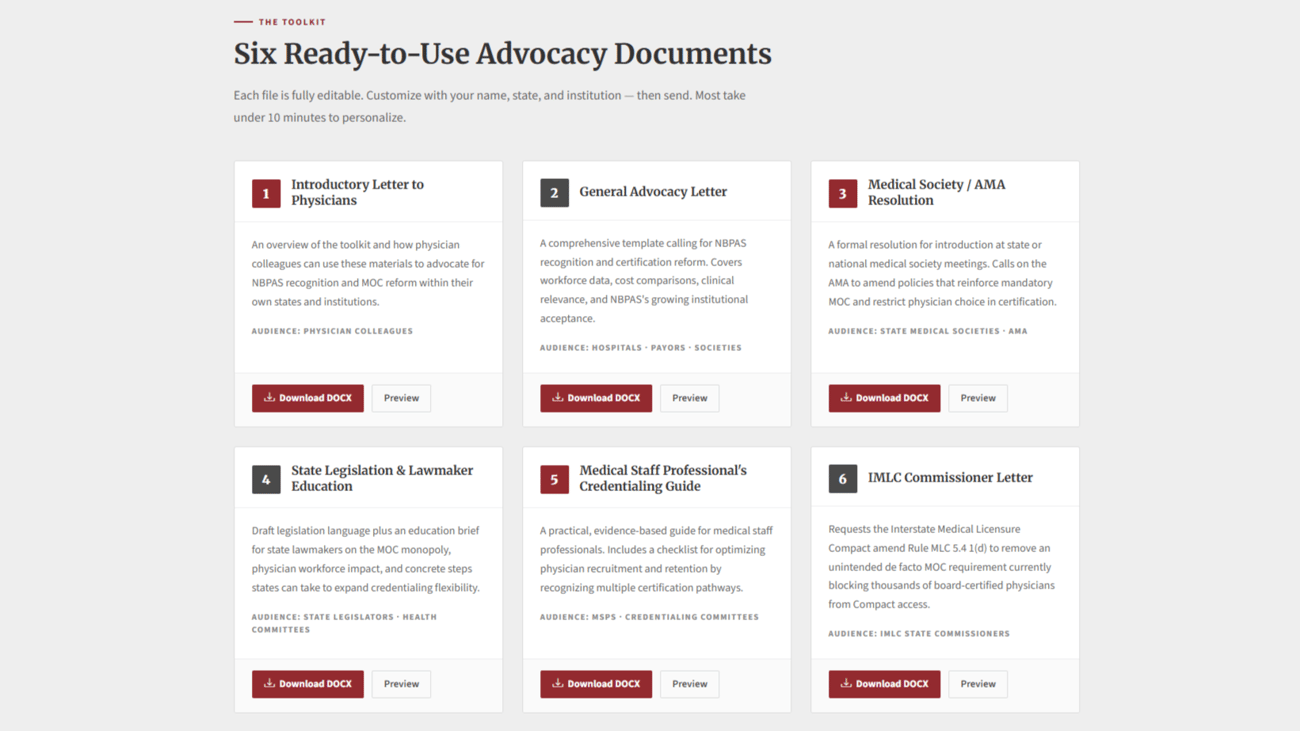
NEW! Physician Advocacy Toolkit
Many physicians have asked how they can take a more active role in advancing change within their hospitals, specialty societies, state medical organizations, and beyond.
To help support those efforts, we've launched the new NBPAS Physician Advocacy Toolkit.
The toolkit includes practical resources physicians can use to support advocacy efforts at the hospital, state, and national levels, including sample letters, policy language, and talking points designed for leadership discussions and organizational outreach.
Meaningful progress depends on physicians remaining engaged in these discussions. We hope these tools help make that process more accessible, informed, and effective for those interested in getting involved.
Hospital Acceptance
NEW Accepting Health System Added!

We're excited to share that Altru Health System now recognizes NBPAS certification.
With 41 locations across Minnesota and North Dakota, this is an exciting addition and another sign that more hospitals and health systems are becoming familiar with NBPAS and the physicians it represents.
Each new organization helps expand opportunities for physicians and continues building momentum nationwide.
Recognizing NBPAS in Hospital Bylaws
As discussions around continuous board certification increasingly make their way into hospitals and medical staff offices, one common question we hear is: "What would recognizing NBPAS actually look like in our bylaws?"
One of the biggest misconceptions is that recognizing NBPAS requires a major bylaw overhaul. In reality, many hospitals have found the process to be far more straightforward, often involving a simple update to existing continuing certification language to include NBPAS alongside ABMS and AOA pathways.
Example bylaw language:
"A physician applicant, MD or DO, must have successfully completed an allopathic or osteopathic residency program approved by the Accreditation Council for Graduate Medical Education (ACGME), the American Osteopathic Association (AOA) and be currently board certified or become board certified within five (5) years of completing formal training or longer as defined by the appropriate specialty board of the American Board of Medical Specialties (ABMS) or the American Osteopathic Association (AOA). Continuing certification may be through the ABMS, AOA, or National Board of Physicians and Surgeons (NBPAS)."
For physicians interested in learning more about how to start these conversations in your own hospitals, additional resources and guidance are available on the Introduce NBPAS to Your Hospital page.
Physicians Corner
"Examining MOC Through a Physician Lens"
Earlier this month, Adam Bruggeman, MD published a powerful five-part LinkedIn series exploring how maintenance of certification has evolved over time, how those changes continue to affect practicing physicians, and why many physicians are increasingly re-evaluating long-standing assumptions around continuing certification.
Rather than simply criticizing the current system, the series looks at how these issues developed, why frustration among physicians continues to grow, and what meaningful progress could look like moving forward.
What makes the series especially worthwhile is that it approaches these topics from the perspective of practicing physicians trying to balance high standards, professional autonomy, patient care, and the realities of modern medical practice.
We appreciate Dr. Bruggeman contributing his thoughtful physician perspective to this important and ongoing conversation.
Read the full series:
- May 4: Maintenance of Certification Controversy
- May 5: The AMA and Certification Standards
- May 6: The Market Has Already Delivered Its Verdict
- May 7: Evidence, Reform, and the Cardiology Revolt
- May 8: Seven Reforms That Would End Mandatory Recertification
Share Your Perspective
If you have a perspective on Maintenance of Certification (MOC) and how it affects your practice, we invite you to share your experience and insights with the NBPAS community. Send your article to info@nbpas.org
One Thing You Can Do This Month
Share These Articles
With so many thoughtful articles and physician perspectives being published recently, one of the most impactful things you can do is share them with your colleagues and professional networks.
Let physicians know they are not alone. Let them know others understand the growing pressures facing the profession. And remind them that when it comes to continuous board certification, physicians do have a choice: NBPAS.
The more physicians share these conversations and support one another, the more awareness and momentum continue to grow.
Physicians Supporting Physicians
Not Yet NBPAS Certified?

More than 15,000 physicians across the country have already joined the growing movement toward a more evidence-based, clinically relevant approach to continuous certification.
NBPAS was created by physicians who believe continuing certification should support lifelong learning and patient care — not repeated high-stakes testing and unnecessary administrative burden.
NBPAS emphasizes:
- Specialty-specific continuing medical education
- Ongoing professional development
- A practical, evidence-based pathway for continuous certification
Requirements include:
- Initial certification from an ABMS or AOA board
- An active, unrestricted medical license
- 50 hours of specialty-specific Category 1 CME within the past 24 months
The application process takes less than 6 minutes to complete.
Suggestions
Have an idea, need help? Reach out to NBPAS at
info@nbpas.org.
Someone from the team will be happy to get back to you.