The Monthly Dose: September 2026
Posted by Jorge Francisco on
The Monthly Dose
September 2026
Insights, advocacy, and updates from NBPAS
Advocacy Updates
Spotlight on Tennessee and Payor Acceptance
In 2018, Tennessee became one of the first states to enact comprehensive legislation limiting the use of Maintenance of Certification (MOC) as a condition of practicing medicine. Under Tennessee law, MOC cannot be required as a condition of medical licensure, payer enrollment or payment, or as the sole basis for denying physician employment, credentialing, or hospital privileges—unless a hospital's medical staff formally votes to require it.
The law also protects physicians from payer discrimination based solely on their decision not to participate in MOC. Tennessee law prohibits health insurers from denying network participation or reducing reimbursement on that basis.
The result? More choice—and less friction—for physicians advocating for NBPAS at their hospital.
Payor requirements are often one of the first questions hospitals raise when physicians seek to add NBPAS recognition to their bylaws. Tennessee's statutory protections help remove that barrier. Today, 14 Tennessee hospitals and health systems recognize NBPAS in their bylaws, and major payors, including Cigna and BlueCross BlueShield of Tennessee, have confirmed that MOC is not a direct or de facto requirement for physician credentialing or enrollment.
Tennessee offers a practical example of how policy can protect physician choice and foster competition among pathways for maintaining board certification and demonstrating ongoing competence.
Are you a Tennessee physician interested in bringing NBPAS recognition to your hospital? Visit NBPAS online resources or contact the NBPAS team—we're happy to support your efforts.
From the NBPAS Desk
Answering Questions About State Advertising Rules
Following NBPAS' recent victory in Florida, where the Florida Boards of Medicine and Osteopathic Medicine approved NBPAS' application and waiver allowing NBPAS-certified physicians to advertise themselves as "board certified," we have received many questions about other state advertising rules—and whether a particular state could be the next to "recognize" NBPAS.
There is a common misunderstanding that a state must formally recognize NBPAS before an NBPAS-certified physician can identify their certification. That is not the case in most states.
Restrictive Physician Advertising Rules Are Rare
Most states do not have rules specifically restricting physicians from advertising themselves as board certified and instead, have rules that focus more broadly on preventing false or misleading claims. Typical medical board advertising language prohibits any misleading, deceptive, or false statements and sometimes requires physicians to name their specific certifying board. In the majority of these states, NBPAS-certified physicians can truthfully identify and promote their NBPAS certification.
A small number of states, most notably Texas and California, take a more restrictive approach. Their rules limit use of the term "board certified" to physicians with "current" certification from an ABMS or AOA member board.
These restrictions were originally intended to prevent non-physicians or unqualified individuals from misleading patients. But the evolution of MOC has created an unintended consequence: physicians who have achieved board certification can be required to participate in a particular MOC program simply to continue to use a terminal board certification credential they already earned.
What Does "State Recognition" Actually Mean?
The concept of "recognition" can be confusing. Some states use online forms or dropdown menus that physicians may use to report their board certification. When those menus include only ABMS boards, it can create the impression that ABMS certification is required by the state, or that only ABMS boards are "recognized." Generally, that is not the case.
In most states, formal recognition of a particular certifying organization is not required for a physician to hold or report board certification. Also important to remember, board certification is not generally required for licensure in any state.
Increasingly, state medical boards are adding NBPAS to their reporting systems, making it easier for NBPAS-certified physicians to accurately report their board certification. Oklahoma provides one example, with NBPAS now included as an option in its physician certification reporting system.
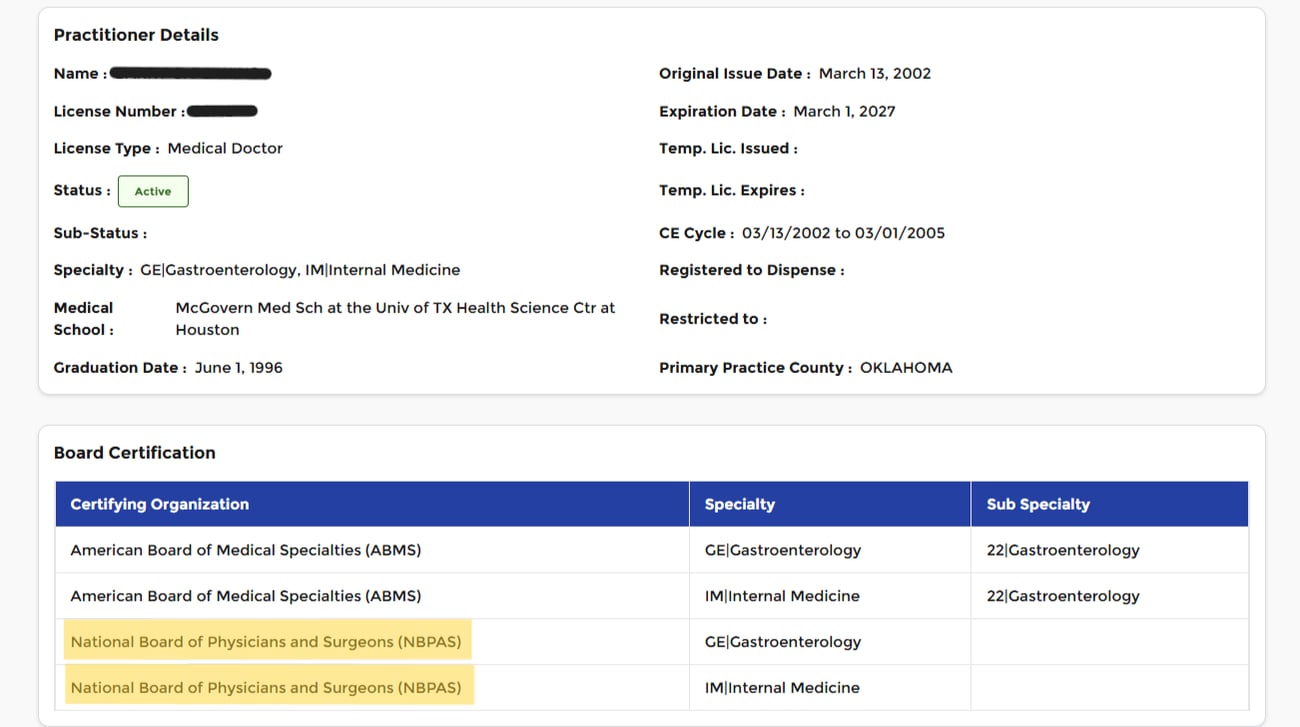
The distinction is important: adding NBPAS to a reporting system is different from changing an advertising rule, and neither necessarily means that a state has formally "recognized" NBPAS, or any other board.
NBPAS will continue to monitor state rules, clarify requirements, and address barriers where they exist. We greatly appreciate physicians who share what they are seeing in their states and advocate for greater choice and competition in physician certification.
Physicians Corner

Florida ACC Voices Support for Physician Choice
We're pleased to highlight a recent statement from the Florida Chapter of the American College of Cardiology supporting the waivers for qualifying NBPAS-certified physicians under Florida's physician advertising rules.
In its statement, the Florida ACC recognized "the importance of physician choice and flexibility while maintaining appropriate standards for specialty certification."
We're grateful to the Florida ACC for its support and for recognizing that high standards and greater physician choice can go hand in hand.
Read the Full Statement: https://accfl.org/Advocacy
One Thing You Can Do This Month
Show Your Support
Physician choice starts with awareness. Wearing an NBPAS lapel pin or badge holder is a simple way to show your support, make NBPAS more visible, and help other physicians recognize that they have options for maintaining board certification.

Physicians Supporting Physicians
Your Certification. Your Choice.
Physicians deserve meaningful options for maintaining board certification. NBPAS offers a physician-led approach centered on clinically relevant CME, lifelong learning, and reducing unnecessary administrative burden.
It's an approach that gives physicians greater choice in how they maintain their certification while continuing to uphold high professional standards.
Join more than 15,000 physicians who have chosen NBPAS to maintain their board certification.
Suggestions
Have an idea, need help? Reach out to NBPAS at
info@nbpas.org.
Someone from the team will be happy to get back to you.